Pulpit restoration. A story waiting to be uncovered


Back in November, Studio Sams was contacted by Father Gerard of St Patrick's Church with a request that would become one of our most meaningful projects to date: a full pulpit restoration of a long-forgotten piece of church history.
At first glance, it sounded like a fairly typical commission within the world of church furniture restoration. But from the moment we stepped inside the church and began to understand its heritage, it became clear this was something far more significant.
A place steeped in Edinburgh’s history
Our first meeting wasn’t about measurements or materials. It was about history.
Father Gerard shared the story of St Patrick’s. A building that has stood at the heart of its community for generations. Long before it became a Catholic church, the site held a different purpose, evolving over time into a place of worship that would serve Edinburgh’s growing Irish population.
A religious space, as much as a cultural anchor. A place where people gathered, connected, and built a sense of belonging in a new city.
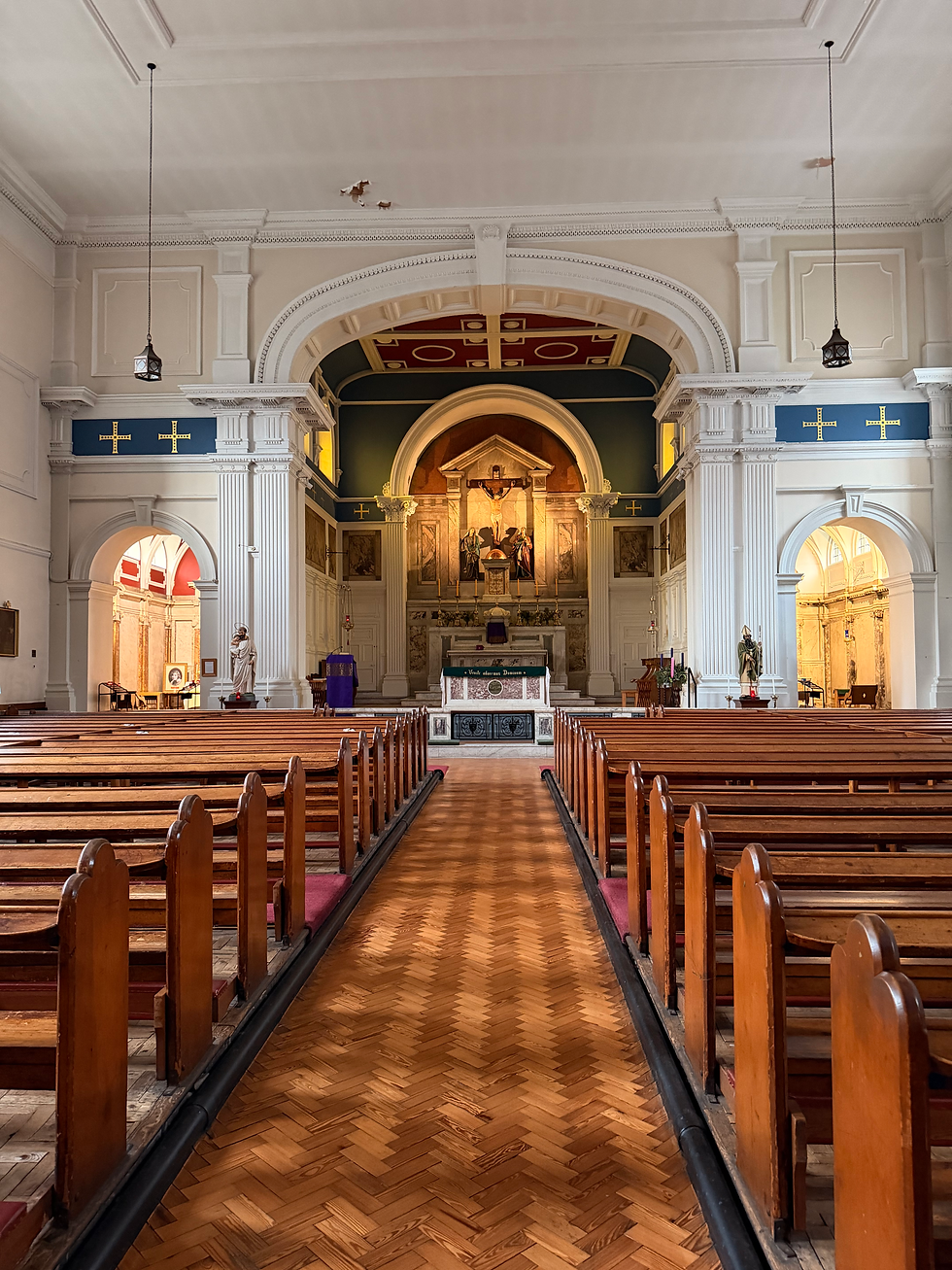
Perhaps most strikingly, the church also holds a unique place in sporting history. It is closely linked to the founding of Hibernian Football Club, a reminder of how deeply embedded it is within the social fabric of Edinburgh.
Sitting there, listening to these stories, it became clear that this wasn’t simply about restoring a piece of furniture. It was about restoring a piece of identity.
The forgotten pulpit — and its origins
The pulpit itself carries far more history than we first realised.
Through conversations with the church and further research, we discovered that the original section of the pulpit dates back to around 1856, when Bishop James Gillis acquired the Cowgate Chapel to serve the growing Irish Catholic community in Edinburgh.
At that time, the Cowgate was at the heart of the city’s Irish population — and St Patrick’s quickly became a focal point for worship, identity, and community.
The pulpit would have been a central feature of that space from the very beginning.
Moving with the times
Around 1890, St Patrick's Church underwent significant changes, including the construction of a new sanctuary extending the north end of the building.
It is believed that during this period:
The pulpit was repositioned within the church
Steps were added to improve access
Additional elements may have been introduced to adapt it to the new layout
This discovery helped explain something we had already begun to notice during our initial assessment: The pulpit was not built all at once. It had evolved.

That evolution would become a key part of how we approached this furniture restoration.
When we first saw it inside the church, it was clear that something was missing. Large sections had disappeared, and what remained hinted at a once intricate and beautifully crafted structure.
It was only when Father Gerard led me to a nearby garage that the full picture emerged.
Rediscovered in storage
Inside the garage, the rest of the story was waiting.
Stored away were the missing elements of the pulpit, pieces that had been removed during restoration work carried out at the church in 2021. The intention had always been to reinstate the pulpit once the wider work was complete, but as is often the case, priorities shifted and the pulpit remained in storage.

What we found were fragments of a once unified structure:
Sections of carved timber
Detached mouldings
Structural components no longer connected
And crucially, several missing elements altogether, including the steps, lectern, and flooring
The pulpit, once a single, commanding piece, now existed in three separate parts.
Yet even in this fragmented state, its craftsmanship was undeniable. The detailing, the proportions, the quality of the timber, all spoke of a piece that had been made with care and purpose.
It wasn’t beyond saving. Far from it.
Why restore it now?
For the team at St Patrick’s, this project had been a long-held ambition.
The pulpit was a visual and functional reminder of its past, and a symbol of continuity for future generations.
Through dedicated fundraising efforts, the church community had finally reached a point where restoration was possible. The timing was particularly meaningful, with a shared goal of returning the pulpit to its rightful place in time for Easter, one of the most important moments in the church calendar.
But this wasn’t about simply putting it back together.
The brief was clear and thoughtful:
Preserve as much of the original pulpit as possible
Restore and repair rather than replace
Recreate missing elements in a way that respects the original design
Adapt the piece so it can function within the church today
This balance between preservation and practicality is at the heart of any true furniture restoration.
The restoration approach
From the outset, the project naturally divided into three key areas, each requiring a different skill set, but all guided by the same philosophy: respect the past while preparing for the future.
1. Restoring the original structure

Wherever possible, the original timber would be retained.
This meant carefully removing old finishes, repairing damaged sections, and stabilising the structure. Every decision was made with the aim of preserving the integrity of the original craftsmanship.
In antique furniture restoration, this approach is essential. The goal is not to erase age, but to honour it, allowing the piece to retain its character while ensuring it is structurally sound.
2. Recreating missing elements
Not everything could be saved.
Some components had been lost entirely, while others were too damaged to reinstate. In these cases, the challenge was to recreate elements that felt as though they had always been part of the original piece.
This included:
Matching existing mouldings and profiles
Replicating decorative details
Ensuring consistency in materials and finish
This stage requires a deep understanding of traditional craftsmanship, not just how something looks, but how it was originally made.
3. Redesigning for modern use

Perhaps the most interesting aspect of the project was the need to adapt the pulpit for contemporary use.
Churches today function differently than they did a century ago, and the pulpit needed to reflect that.
This included:
Designing and building new steps to improve accessibility
Creating a new lectern suitable for modern services
Incorporating discreet storage solutions for microphone receivers, papers etc.
The aim was to ensure the pulpit could once again serve the church, not as a static historical object, but as a living, functional part of the space.
A privilege to restore
For me, projects like this go far beyond craftsmanship.
They are about connection to history, to community, and to the people who will continue to use and value the piece long after the work is complete.
This really was an amazing opportunity to bring life back to a once-loved pulpit for the church community. That sense of responsibility is something we carry into every stage of the process.
Time to get to work
Standing in that garage, surrounded by fragments of the past, it was easy to imagine the scale of the task ahead.
But it was also clear what the end goal would be.
To take something forgotten and fragmented… and return it to the heart of the church where it belongs.
Over the coming weeks, we’ll be sharing the full journey of this pulpit restoration, from careful dismantling and repair, through to reconstruction and final installation.
Each stage brings its own challenges, discoveries, and moments of craftsmanship.
And with each step, the pulpit moves closer to being part of St Patrick’s once again.


Comments